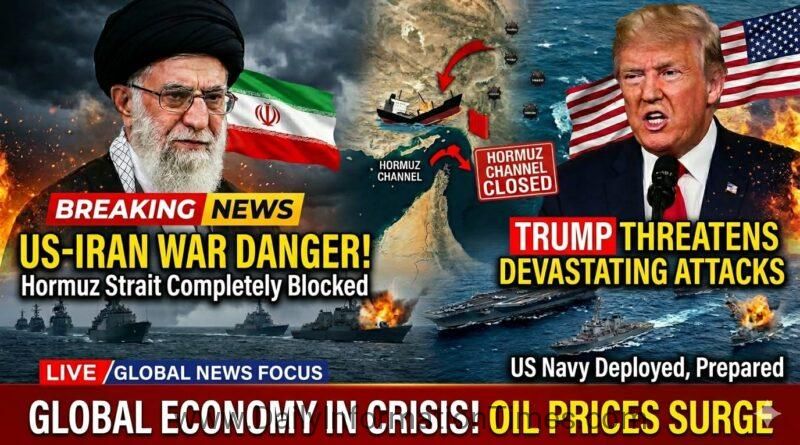
U.S. Issues Stern Warning to Iran: Threats of Devastating Attacks and Closure of the Strait of Hormuz
WASHINGTON/TEHRAN: Tensions between the United States and Iran have once again reached an extremely dangerous level, with harsh statements and military movements from both sides sending shockwaves of concern globally. U.S. President Donald Trump has issued a direct threat to Iran, stating that until a “real and effective” deal is implemented, all U.S. troops, warships, and advanced weaponry will remain in their positions within and around Iran’s borders.
President Trump’s Warning and Conditions
The U.S. President made it clear that if Iran engages in any form of provocation, the United States will launch attacks with “such force that the world has never seen before.” He stated in no uncertain terms that it had already been decided that Iran would not possess nuclear weapons and that the Strait of Hormuz—the world’s most critical trade route—must remain open and secure at all costs.
Iran’s Response and Situation in the Strait of Hormuz
On the other hand, Iran has announced the complete closure of the Strait of Hormuz. According to Iranian media, fears have been raised regarding the presence of sea mines in certain parts of the strait. The Iranian Ports and Maritime Organization has designated alternative routes, stating that vessels passing through the area must now cooperate with the Iranian Revolutionary Guard Corps (IRGC). According to reports, Iran is also planning to collect a “toll tax” from ships passing through this route and has informed international mediators of this decision.
Impact on Global Economy and Stock Markets
Due to this escalation, global crude oil prices have surged by up to 2.5%, with Brent crude prices seeing a significant spike. Asian stock markets, including indices in Japan, Shanghai, and Mumbai, recorded major declines ranging from 1% to 1.75%. A mixed trend is also being observed in the Pakistan Stock Exchange due to the situation.
Concerns from International Organizations
The IMF, World Bank, and the World Food Programme have warned in a joint statement that a war in the Middle East would paralyze not only the region but the global economy and food supply. According to the statement, rising oil and gas prices will create transport issues, with the heaviest burden falling on poor and import-dependent countries. Iranian Foreign Minister Abbas Araghchi, addressing the United States, said that Washington must choose whether it wants a ceasefire or intends to push the region into the flames of war through Israel.
Intellect, Integrity, Leadership: Why Dr. Maqsood Jafri Stands Out for AJK President
Daily Information Times
Editor: Syed Bilal Izzat Naqvi
Stay Updated – Follow Our Official Page
Follow us on Facebook